The One Skill Separating Employed Nanotech PhDs From the Ones Still Waiting by the Phone
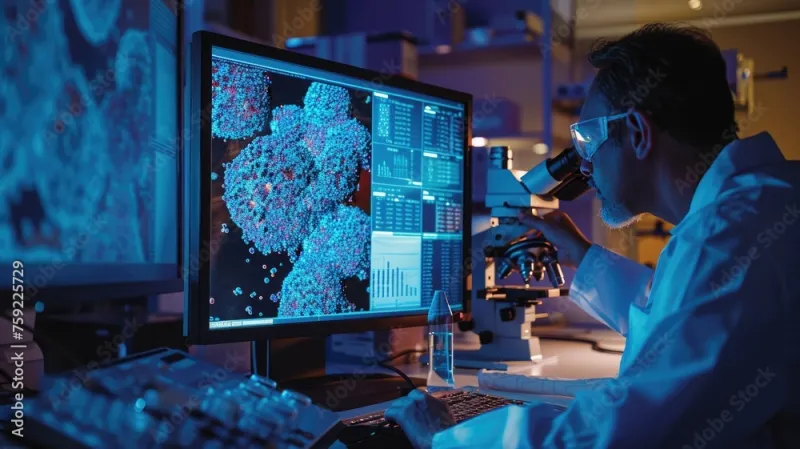
Photo: scientist analyzing electron microscopy data on computer screen laboratory, via as2.ftcdn.net
Here's a scenario that plays out more than anyone in academia wants to admit. A freshly minted PhD walks into an interview at a nanotech firm somewhere in the Research Triangle or out in Silicon Valley. Five years of graduate work. A dissertation. Conference posters. Letters of recommendation from people whose names you'd recognize. And then the hiring manager asks them to look at a set of characterization outputs—XRD patterns, AFM surface maps, maybe some TEM diffraction data—and explain what's actually going wrong with a fabrication run.
Silence.
Not because the candidate is dumb. Not because they've never seen those instruments before. But because there's a massive, uncomfortable difference between generating characterization data and reading it like a diagnostic tool. And right now, that gap is quietly eating the nanotech talent pipeline alive.
The Instrument Operators vs. the Interpreters
Let's be blunt about what most nanotech graduate programs actually train you to do. You learn to operate equipment. You learn the theory behind why an X-ray diffractometer does what it does, or why atomic force microscopy gives you the surface topology it gives you. You run samples. You export files. You hand those files to your advisor, who nods, scribbles something, and tells you to adjust a parameter.
What you don't learn—at least not systematically—is how to treat characterization data the way a clinician treats a patient chart. How to look at a broadened XRD peak and immediately triangulate whether you're dealing with grain size effects, instrument broadening, or strain from a deposition process gone sideways. How to see a weird artifact in an AFM scan and know, instinctively, whether it's real topography, tip contamination, feedback loop oscillation, or something in your sample prep that needs to change.
That interpretive fluency—what some in the industry call characterization literacy—is what separates the people who get hired and actually contribute from day one versus the people who need six to eighteen months of hand-holding before they're useful.
Why Universities Keep Producing the Same Gap
The reasons this skill doesn't get taught well are almost depressingly structural. Graduate advisors are optimizing for publications, not workforce readiness. You run the experiment that supports the paper's argument. Anomalous data gets explained away or buried. You rarely spend serious time sitting with broken or ambiguous data and working backward to a root cause.
Undergraduate programs are even further removed from this kind of diagnostic thinking. If you're lucky, you get a materials characterization course that covers the theory of each technique in isolation. Nobody builds a curriculum around handing students a messy, real-world dataset and saying: something is wrong here, figure out what it is and why.
Self-taught engineers and bootcamp-style nanotech learners—a group this site has covered before—actually sometimes do better here, weirdly enough. When you're figuring things out on your own, you spend a lot of time staring at results that don't make sense and troubleshooting them without a safety net. That builds a kind of interpretive muscle. But it's inconsistent and unsystematic, and it doesn't scale.
What Companies Are Actually Doing About It
Talk to hiring managers at mid-size nanotech firms—the ones working on semiconductor process development, advanced coatings, nanomedicine platforms, or next-gen battery materials—and a pattern emerges fast. Virtually all of them have built some version of an internal onboarding program specifically designed to close the characterization literacy gap.
At some companies, this looks like a structured rotation where new hires spend their first few months doing nothing but characterization triage on production samples—learning to flag issues, document patterns, and build intuition under the supervision of a senior process engineer. At others, it's more informal: a senior staff member who essentially runs a shadow curriculum alongside a new hire's actual job responsibilities.
Either way, it costs money. Real money. One process engineering manager at a North Carolina nanofabrication startup (who asked not to be named because, quote, "we'd rather our competitors not catch on") estimated that closing this gap for a new hire runs somewhere between $40,000 and $80,000 in loaded time and resources before that person is operating independently. For a startup, that's not a rounding error.
"We're basically running a graduate program inside our company," she said. "Except we're paying people a salary while we do it."
What You Should Be Doing Right Now
If you're still in school—grad or undergrad—the move is straightforward, even if it takes some initiative. Start treating every piece of characterization data you generate as a diagnostic puzzle, not just an output to report. When something looks off, don't move on. Dig. Ask your advisor why the peak looks like that. Ask the facility staff what they've seen on that instrument that looked similar. Build a personal reference library of "weird data" and what caused it.
Seek out labs or research groups that do failure analysis or process development work, not just synthesis. Those environments force you to develop interpretive skills because the whole point is figuring out why something didn't work.
If you're job hunting right now and feeling the sting of this gap, be honest with yourself about where your blind spots are. Can you look at a TEM image and tell the difference between a real nanostructure and a preparation artifact? Can you read an XPS spectrum and catch a surface contamination issue before it invalidates your results? If the answer is shaky, there are resources—NIST has published extensively on characterization standards and interpretation frameworks, and some national labs run short courses through their user facilities that are genuinely worth the time.
And if you're early in your career and get the chance to work alongside a senior characterization specialist, treat that like the most valuable professional development opportunity you'll ever have. Because it probably is.
The Bigger Picture
Nanotech as an industry is still maturing, and a lot of the infrastructure—including the training infrastructure—is being built in real time. Universities are slow to adapt. Companies are filling the gap with expensive internal programs. And in the middle of all that, there are a lot of talented people who worked incredibly hard for their credentials and are still getting passed over because they can't do the one thing the job actually requires on day one.
Characterization literacy isn't glamorous. It doesn't make for a flashy conference talk. But it is, right now, the closest thing nanotech has to a universal job skill. Get good at it, and you're not just employable—you're the person every team needs.