Silicon Anodes Left the Lab. The Supply Chain Is Still Catching Up.
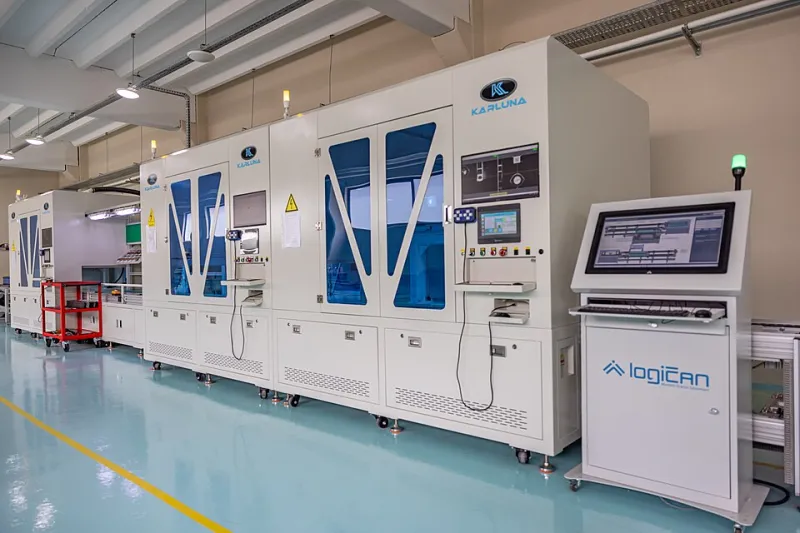
Photo: MelihSolmaz, CC BY-SA 4.0, via Wikimedia Commons
For years, silicon anodes were the battery world's favorite promise: more capacity than graphite, lighter weight, and a path to faster charging. The catch was that silicon swells when it absorbs lithium, cracking the anode and killing cycle life. Nanoscale engineering — porous silicon scaffolds, carbon coatings, composite particles — has spent the last decade solving that problem. In 2026, the solution is finally shipping. The supply chain is another story.
What changed
The core trick is to give silicon room to breathe. Instead of using solid silicon particles, manufacturers build porous structures or embed silicon in a carbon matrix. When lithium moves in, the silicon expands into the empty space instead of pushing the whole electrode apart. The nanoscale architecture also shortens the diffusion path for lithium ions, which helps with charging speed.
Companies like Sila Nanotechnologies, Group14 Technologies, Amprius, and Enovix have spent years turning those ideas into production processes. Sila's silicon anode material has been designed into Mercedes-Benz EVs. Group14 has been building out capacity in Washington State and working with battery partners in Asia and the US. Amprius has focused on high-energy cells for drones and specialty applications. Enovix has been pushing its own cell architecture for consumer electronics and EVs.
The common thread: none of this works without precise control at the nanoscale. The particle size, the pore structure, the carbon coating thickness — all of it has to be consistent batch after batch. That's a manufacturing problem as much as a chemistry problem.
The silane bottleneck
One of the less-discussed constraints is silane gas. Several silicon anode processes use silane as a precursor. Producing and handling silane at industrial scale is not trivial. It's pyrophoric, meaning it can ignite on contact with air, and it requires specialized equipment and safety systems. The US has silane capacity, but not enough to support a sudden boom in silicon anode production.
Group14's Moses Lake, Washington facility is one example of the buildout. The company has been expanding capacity there and has talked about supplying battery manufacturers in the US and abroad. Sila has also been building manufacturing capacity, including a facility in Moses Lake. The region has become a small hub for battery materials, partly because of cheap hydropower and partly because of state and federal incentives.
But building a plant is not the same as qualifying a material with a customer. Battery makers are conservative. They want to see thousands of cycles, consistent quality, and a supply chain that won't break. That qualification process takes time, which is why the silicon anode rollout looks less like a light switch and more like a dimmer.
The porous carbon question
Many silicon anode designs rely on porous carbon scaffolds. The carbon provides conductivity and mechanical support. Making that carbon with the right pore size and surface chemistry is its own manufacturing challenge. Some companies make it in-house; others buy it from suppliers. The supply chain for battery-grade porous carbon is still thin, and it's not concentrated in the US.
That matters for domestic battery production. The Inflation Reduction Act's incentives for US-made batteries have pushed companies to localize more of the supply chain, but localization is easier for cell assembly than for specialty materials. A battery cell can be assembled in Michigan or Georgia, but the silicon anode powder might still come from a plant in Washington or from overseas.
What it means for US manufacturing
The US has a chance to own a meaningful piece of the silicon anode supply chain, but it's not guaranteed. The country has strong research labs, a growing battery materials cluster in the Pacific Northwest, and federal money flowing into battery manufacturing. It also has permitting delays, a shortage of skilled process engineers, and competition from Asian battery makers who have been scaling silicon anodes for longer.
The companies that succeed will be the ones that treat manufacturing as a core technology, not an afterthought. That means investing in metrology — measuring particle size, porosity, and coating uniformity at production speed — and in the mundane logistics of moving hazardous precursors safely.
The consumer angle
For everyday electronics, silicon anodes mean longer runtime or thinner devices. For EVs, they mean more range or a smaller battery pack. Neither benefit is free. Silicon anode cells can cost more per kilowatt-hour than graphite cells, at least until production scales. The first customers will be premium products where performance matters more than cost.
That's how technology adoption usually works. The early market is expensive and niche. Then the supply chain matures, costs come down, and the technology moves into the mainstream. Silicon anodes are in that early phase now. The lab results are real. The factories are real. The question is whether the supply chain can keep up with the hype.
The bottom line
Silicon anodes are no longer a science project. They're a manufacturing project. The nanoscale engineering that made them possible is impressive, but the next few years will be decided by silane supply, porous carbon capacity, qualification timelines, and the willingness of US manufacturers to invest in unglamorous process engineering. The battery world has been waiting for this moment. Now it has to build the plumbing.