Sweat, Breath, and Skin: Five Nano Sensors Closing In on Your Wrist
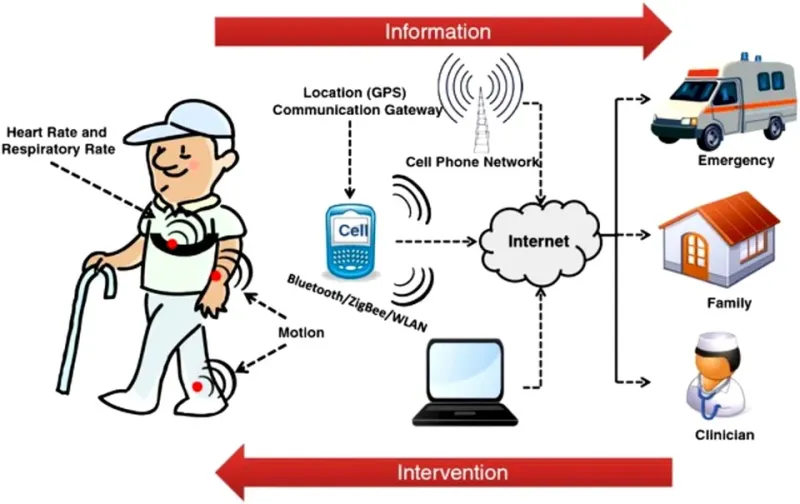
Photo: Aaron Asael Smith, Rui Li, Zion Tsz Ho Tse, CC BY 4.0, via Wikimedia Commons
Every few months a startup announces a sensor that will read your body's chemistry from a patch, a breath, or a bead of sweat, and every few months the ship date moves. That's not because the science is fake. It's because moving a nanomaterial from a clean, controlled lab bench onto a sweaty human forearm is one of the harder engineering problems in diagnostics.
Still, the gap is narrowing. Here are five nano-enabled sensor categories worth tracking in 2026 — ranked roughly by how close they are to something you can actually buy.
1. Lateral-flow tests with engineered nanoparticles
What it is: The at-home rapid test you already know, upgraded. Gold nanoparticles are the classic label in lateral-flow assays, and newer work swaps in quantum dots, upconverting phosphors, or magnetic beads to push sensitivity and let a phone camera do the reading.
Status: Shipping. This is the least speculative entry on the list. Lateral-flow formats are cheap, shelf-stable, and manufacturable at scale — the three things that kill most sensor concepts.
The wall: Sensitivity per dollar. Squeezing out clinically meaningful detection limits without adding a reader, a heating step, or a cold chain is where most of the engineering effort goes.
What to watch: Any at-home test that claims lab-grade quantification from a cassette alone. Ask what the reader costs and whether the result is a number or just a yes/no.
2. Microneedle patches that sample interstitial fluid
What it is: An array of microscopic needles, often polymer or silicon, that penetrates the dead outer layer of skin and pulls biomarkers from the fluid between cells — the same compartment continuous glucose monitors already exploit.
Status: Early commercial, mostly in wellness and sports-adjacent products. Clinical-grade versions for anything beyond glucose are still in trials.
The wall: Two of them. First, interstitial fluid lags blood chemistry by minutes to hours, which matters enormously for anything acute. Second, the microneedles are a materials problem: consistent geometry, sterile manufacturing, and skin-irritation profiles all have to clear regulatory review, and nano-engineered surfaces make the manufacturing story harder, not easier.
What to watch: Any patch claiming multi-analyte readouts — lactate, glucose, and cortisol from one disposable — because that's where the drift and cross-sensitivity problems compound.
3. Breath analyzers with nanostructured sensing layers
What it is: Metal-oxide or carbon-nanotube sensing films with enormous surface area, designed to catch trace volatile compounds in exhaled breath — acetone for fat metabolism, ammonia, or inflammation markers.
Status: Consumer ketone breath meters exist. Anything diagnostic is much earlier.
The wall: Breath is a terrible sample matrix. Humidity swings wildly, hundreds of compounds overlap, and the same sensor can drift after a few dozen uses. Nanostructured films are extraordinarily sensitive, which is exactly why they're also easily fooled. Selectivity, not sensitivity, is the bottleneck.
What to watch: Calibration claims. A breath device that needs monthly re-baselining is a gadget, not a diagnostic.
4. Graphene and nanomaterial dry electrodes for cardiac and muscle signals
What it is: Conductive films and textile-integrated nanomaterials that pick up electrical signals without conductive gel — the thing that makes long-term ECG patches practical.
Status: Closest to boring-and-useful. Dry electrodes are already in some consumer heart-rate straps and clinical patch trials. Nano-enabled versions are competing on comfort and signal-to-noise against established conductive polymers.
The wall: Skin contact under motion. A nanomaterial that performs beautifully on a still chest becomes a noise generator when you sweat and move. Longevity under repeated wash-and-wear cycles is the other quiet killer.
What to watch: Wash durability data. If a wearable maker won't publish how the electrode performs after fifty cycles, assume they haven't measured it.
5. Sensor-integrated smart bandages and wound patches
What it is: Flexible patches that monitor pH, temperature, or bacterial markers in a wound and signal infection before it's visible — a genuine clinical need, especially for diabetic foot ulcers and post-surgical care.
Status: Trials and pilot programs. Nothing mainstream yet.
The wall: Regulation and reimbursement, more than physics. A wound sensor has to be cheap enough to be disposable, stable enough to sit on an open wound for days, and reimbursable enough that a hospital buys it. That last one has ended more promising devices than any chemistry problem.
What to watch: Whether any of these land as durable medical equipment or stay in the cash-pay pilot limbo where so much smart-textile tech lives.
How to read the next announcement
Three questions cut through most of the noise. Does the device produce a number a clinician would act on, or a trend line? Has anyone published performance in real humans under real conditions, not buffered saline at room temperature? And is there a manufacturing line behind it, or a bench and a slide deck?
None of this is a knock on the materials science, which is genuinely impressive. But the nanomaterial is the easy part. The sample, the calibration, the manufacturing, and the billing code are where these things live or die — and where your wrist will or won't get a new sensor this year.