You Can't Fix What You Can't Measure: The Nanotech Metrology Crisis Nobody Wants to Talk About
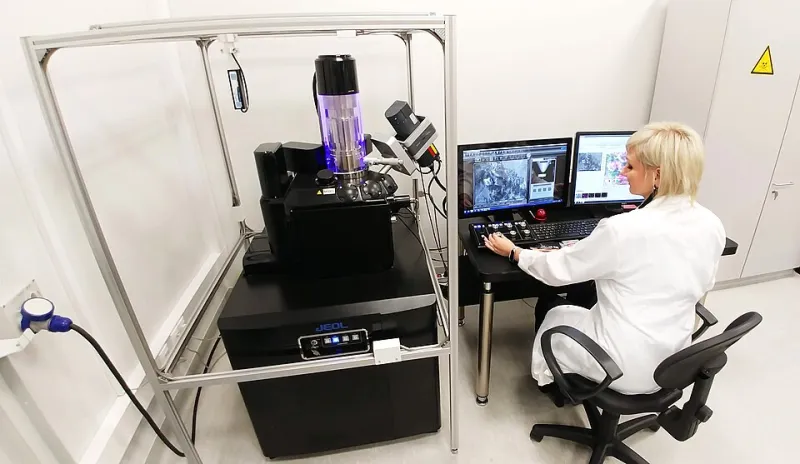
Photo: Gabriela P., CC BY 4.0, via Wikimedia Commons
Here's a question that doesn't get asked nearly enough at nanotech conferences: once you've engineered something at the nanoscale, how do you actually know you built the right thing?
Not roughly. Not probably. Know.
For a lot of companies working at the cutting edge — whether they're fabricating next-generation chips, engineering drug delivery nanoparticles, or developing advanced coatings for aerospace — the honest answer is increasingly uncomfortable. They're spending enormous resources just to characterize what they've made, often with instruments that weren't designed for the job, using measurement protocols that vary wildly from lab to lab, and arriving at results that may not be reproducible anywhere else on earth.
Welcome to nanotech's dirty little secret: the metrology problem.
What We Mean When We Say "Metrology"
Metrology is the science of measurement. At human scales, it's solved. A meter is a meter. A kilogram is a kilogram. Standards bodies like NIST have spent decades making sure that when a manufacturer in Ohio measures something, it matches what a supplier in Taiwan measures.
At the nanoscale, that infrastructure is still being built — and in some areas, it barely exists at all.
When you're working with structures between one and a hundred nanometers, the tools you use to observe those structures can actually alter them. Electron beams damage samples. Tip geometry in atomic force microscopy introduces artifacts. Sample preparation for transmission electron microscopy can change the very thing you're trying to see. And because no two instruments are perfectly identical, measurements taken on different machines — even the same model — can diverge in ways that matter enormously at this scale.
For a nanoparticle intended to carry chemotherapy drugs to a tumor, a size variance of even a few nanometers can change how it behaves in the bloodstream. For a transistor gate measured incorrectly during quality control, the downstream consequences ripple through an entire chip design. The stakes are not abstract.
The Hidden Tax on Nanotech Innovation
Industry insiders sometimes call it the "characterization overhead" — the time, money, and talent that gets consumed not in building new things, but in verifying what you've already built.
At major semiconductor fabs, this overhead has become staggering. As node sizes have shrunk below 5nm, the metrology tools required to inspect those features have grown more exotic and expensive. Extreme ultraviolet scatterometry, electron beam inspection systems, X-ray photoelectron spectroscopy rigs — the capital expenditure for a serious characterization suite can run into the tens of millions of dollars, and that's before you factor in the specialized PhDs required to run them.
Smaller companies get hit even harder. A nanotech startup working on novel battery materials or a university spinout developing nanoscale sensors doesn't have the budget for a $15 million cryo-electron microscope. They're often cobbling together measurements from contract labs that use different protocols, different calibration standards, and different software for data interpretation. The result is a kind of measurement fog — everyone is technically doing science, but nobody's quite sure if their numbers mean the same thing as someone else's numbers.
This isn't just inefficient. It actively slows down the field. Reproducibility, the bedrock of scientific progress, becomes genuinely difficult when the act of measuring is itself inconsistent.
Pharma Is Feeling It the Most
If semiconductors represent the high-profile face of the metrology problem, pharmaceuticals are where the consequences get most personal.
The FDA has been pushing nanomedicine developers for years to provide better characterization data on their nanoparticle drug formulations. But the agency itself has acknowledged that standardized reference materials and validated measurement methods for nanoparticles are still catching up to the science. When a company submits a new drug application for a lipid nanoparticle therapy — the same delivery technology that made mRNA COVID vaccines possible — the characterization data required is extensive, expensive, and often generated using methods that aren't fully harmonized across the industry.
The result? Drug developers sometimes run the same sample through five different characterization techniques, get five somewhat different answers, and then have to make a judgment call about which number to put in their regulatory submission. That's not a great position to be in when you're trying to prove to the FDA that your nanoparticle is consistently 80 nanometers in diameter and not, say, 120.
The National Cancer Institute's Nanotechnology Characterization Laboratory has done important work here, providing standardized assay protocols and reference measurements. But it's a single institution, and the demand from industry dwarfs its capacity.
Who's Winning the Metrology Arms Race
Here's where the competitive angle gets interesting. Because while the measurement gap is a problem for the field overall, it's also quietly becoming a source of differentiation for companies sophisticated enough to take it seriously.
The chip giants — TSMC, Intel, Samsung — have invested so heavily in proprietary metrology capabilities that their measurement infrastructure is itself a competitive moat. They're not just better at building chips; they're better at knowing what they've built. That closed-loop feedback between fabrication and characterization is a huge part of why leading-edge nodes keep advancing while everyone else struggles to catch up.
In materials science, companies like Thermo Fisher Scientific and Bruker have built substantial businesses just selling the instruments required to peer into the nanoscale world. The metrology market isn't a footnote — it's a multi-billion dollar industry in its own right, and it's growing faster than most people outside the sector realize.
For startups, the lesson is harsh but clarifying: if you can't measure it reliably, you can't scale it. Investors are starting to ask harder questions about characterization methodology, especially in nanomedicine, where FDA scrutiny is intense. The companies that have built rigorous internal metrology programs — even at significant cost — are finding it easier to raise money, close partnerships, and navigate regulatory pathways.
Standards Are Coming. Eventually.
ISO, ASTM, and NIST are all working on nanoscale measurement standards. The progress is real but slow, constrained by the usual challenges of international consensus-building and the pace of academic publication. For a field moving as fast as nanotech, "we're working on it" can feel like cold comfort.
There's growing pressure from industry coalitions, particularly in semiconductors and pharma, to accelerate the development of certified reference materials — essentially, nanoscale objects of precisely known properties that labs can use to calibrate their instruments and validate their methods. Some of these already exist for specific applications, but the coverage is patchy.
Until the standards infrastructure catches up, the metrology gap will remain what it's always been: an invisible bottleneck, quietly throttling the industries that depend on working confidently at scales too small to see.
The future of nanotech gets measured in nanometers. The problem is that right now, not everyone is using the same ruler.